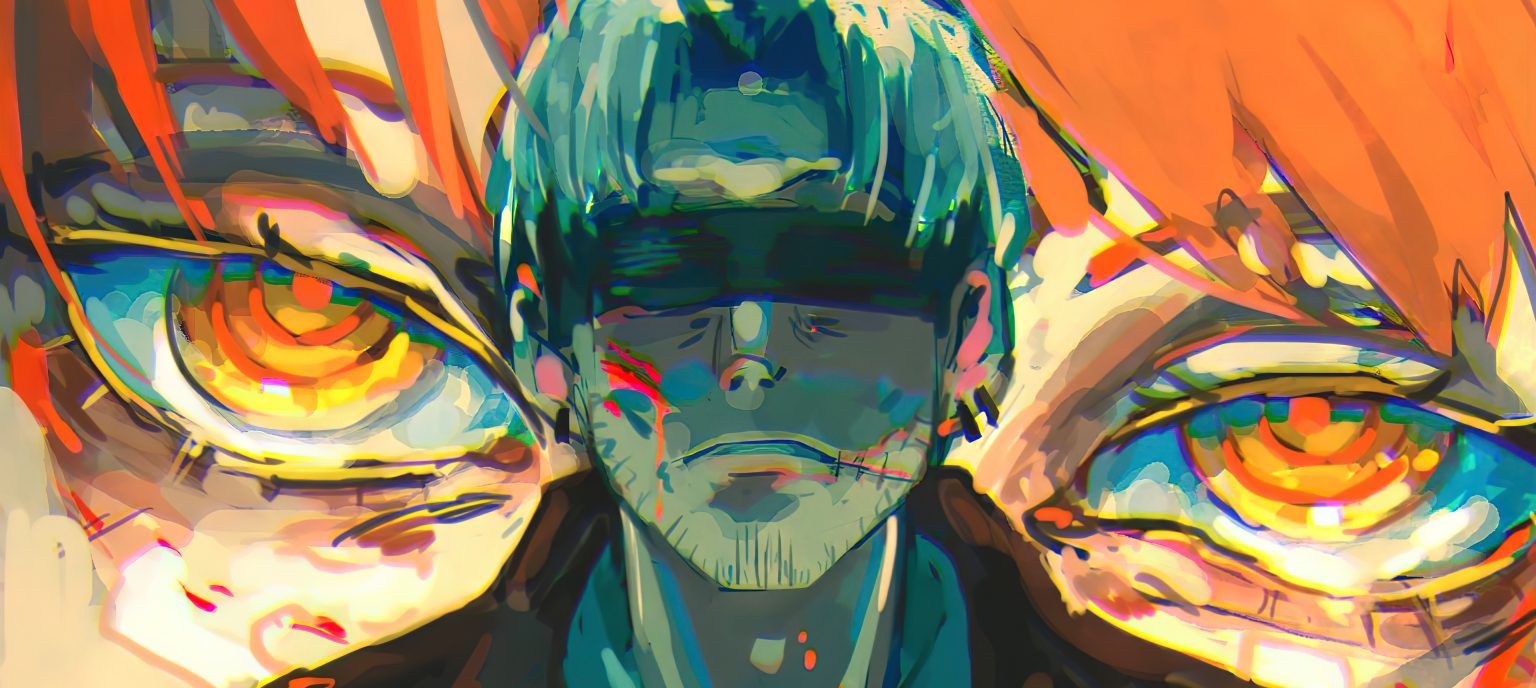
Chainsaw Man
8 minutes • September 23, 2023 • Thoughts
WARNING: DISCUSSIONS ON SEXUAL THEMES LIE AHEAD. IF YOU ARE UNCOMFORTABLE WITH TALK ABOUT SEX, PRESENTATIONS OF SEX IN MEDIA, OR ANYTHING SEX RELATED, TURN BACK NOW
Going into Chainsaw Man, I had high expectations. It had high ratings and was recommended by friends who generally give good recommendations. After going through stories like Berserk and Attack on Titan, I was ready for another hard-hitting storytelling experience from Japan. I prepared, but I prepared in the wrong ways. Chainsaw Man managed to slip by my defenses, come up behind me, and stab me with characters I actually like, undergoing arcs that I actually relate to and feel. It’s not hyperbole to say that Chainsaw Man has altered how I view and review media.
What I mean is, when I watch or play or read a story, a lot of times I feel like I’m relating to something outside of my immediate experiences. When I watch The Sopranos, I don’t actually know what it’s like to be someone in the mafia in New Jersey. Similarly, when I read a book like Frankenstein, I don’t know what it’s like to live in 19th century Europe. For a lot of stories, I feel as if I’m relating to the experiences of someone outside what my daily life consists of, and most likely outside anything I will experience. However, even though I am not a mob boss or an 18th-century proto-scientist, empathizing with human experience and relating those experiences to my own life is something I love to do. The Sopranos, for example, shows a more human element to these people mythicized in American media and culture, including showing the mob boss Tony going to therapy, having panic attacks, and dealing with the realities of family. Frankenstein questions humans’ responsibility for ethics in science and examines life through the lens of the creator, as well as the ill-begotten receiver of it. Even though these people are foreign to our own identities, through their stories we can learn a lot about our own lives and how we should navigate them.
This, in isolation, was my view until I watched Chainsaw Man. I still believe everything above, but now that I’ve seen a critically acclaimed work deal with experiences that relate to who I am as a human, I realized I’ve been neglecting my personal relation to media in favor of what I can abstractly absorb and repurpose for my own life.
I want to make it very clear right here that Chainsaw Man is not for your average person. It’s bloody, it’s immature, it’s sexual, and it’s from Japan. If you don’t like any of these elements, Chainsaw Man is probably not for you. To me, I find that when these elements are mixed together, usually one of those elements I listed is overdone and the story suffers significantly because of it. Yet despite having all these things, Chainsaw Man manages to navigate through the perilous pitfalls this genre regularly finds itself in and come out with some likable characters and a fun, if not somewhat unimpressive main plot. Before you go on, let me make it ultra clear that these thoughts that I’m penning are not a recommendation for everyone, but rather a recording of how I felt after watching and then reading Chainsaw Man.
With that out of the way, let me try painting a picture of what I loved so much about Chainsaw Man. We start with our main character Denji, a standard dumb kid, but super lovable with a good heart. The story starts with him working to pay off his father’s 39 million yen debt to the Yakuza, selling organs, taking up dangerous work, and going home at the end of the day with nothing but bread, 12 dollars to live on for the rest of the month, and his chainsaw/dog hybrid Pochita.
Despite these grim circumstances, Denji keeps chugging on, daydreaming of things like having jam on his bread and hugging a woman before he dies. Simple, but relatable goals.
His employers have different plans, however, eventually choosing to sacrifice him to make a deal with a devil, then throwing him and his dog’s corpses in a dumpster. Fortunately for Denji, his chainsaw demon dog decides to make a deal with him to bring him back to life. All Pochita asks for is to tag along to see Denji achieve all his dreams.
After using his new chainsaw powers to take revenge on his employers, a woman sent to kill his employers named Makima grabs the worn-out Denji as he falls, hugging him before he hits the ground. She gives Denji a choice: either be killed or come work for her. If he does work for her, she’ll even give him food, including a breakfast that features the mythical bread with jam on it. Denji is ecstatic. This is it: he made it. All his wildest dreams are coming true. Makima comes off as a hard ass, but the smallest amount of affection from his new boss immediately pushes him head over heels in love with her.
It is this love that motivates him to work. This work fuels most of the plot, but it’s through this work that Denji grows his dreams. After he realizes that he has secured some level of life security (has a job, shower, and works near a woman) and already achieved both of his life goals, he begins pondering about other things he could achieve in life. It’s then that he realizes a goal he had forgotten, a dream so far off that he didn’t even remember: he wants to touch a boob. Now, this is where I’d usually dip out of a story. This guy has been deprived his entire life, forced to work and keep nothing for himself. It might be an animalistic, base goal that seems silly, but honestly, this is a super grounded goal that most men can relate to.
And it’s not just the goal, but it’s the intensity of how he goes about it. After getting paired with another girl with powers called Power to hunt down devils, he almost instantly realizes that he hates this girl. However, nearly at the same time, he also realizes she has boobs. Every time he is about to go off on her, he keeps his goal in mind and refocuses. He finds out that this chaotic girl who seems to hate everyone and everything, loves cats. She tells Denji that she used to have a cat, but she needs his help to rescue her from the clutches of a demon. In return, she’ll give him anything. You can see the gears in Denji’s head turning: this is his chance. He agrees on one condition. She agrees, and Denji goes to work.
It turns out, Power was trying to lure Denji to this demon in exchange for the life of the cat. Denji fights hard against the demon and the demon’s girlfriend who gets angry that Denji killed the demon. In the end, Denji prevails, although barely, protecting Power from death and saving the cat.
With this victory, Power agrees to give him what he most desires. But it’s only after Denji claims his reward (three squeezes) that he realizes how empty the experience was. He begins to doubt the purpose of his dreams. Was it really worth it? Why does he even care about an experience that is ultimately so empty?
This is where the most compelling part of Chainsaw Man begins. The plot itself is grim, people take advantage of Denji, people are dying, devils roam the world and kill the innocent. Yet, the narrative is lighthearted. Denji is upbeat and looks towards concrete goals which he strives to achieve. This goal, which Denji discovers to be ultimately hollow, is a goal that used to be promoted by society at large. Culturally, we push men towards sex without attachment, to “sow their wild oats.” But this was the old way of going about things, and a lot of men have realized how empty an experience that can be. So what does Chainsaw Man say that Denji, and men in general, should do about this?
Makima, who calls Denji in after work to fill out paperwork relating to his kills on the demon, notices he’s down and asks him what’s wrong. He tells her about how he recently achieved a long-time dream of his and how its emptiness has given him doubts about his future dreams and left him depressed. He asks if he is going to realize that he was happier during the chase than when he actually achieves his future goals. Confused, Makima asks him what this is about. Denji then tells her about his deal with Power. In response, Makima grabs his hand and tells him that “naughty things feel better when you know your partner.” She holds his hand. Then she moves his hand to her boob. Denji, who is sitting, falls out of his chair, grabbing his heart. She then moves close to him, and right before their mouths touch, she asks him for a favor. If he can kill the Gun Devil, she’ll grant him any wish. The cogs turn again.
It’s this human answer to why this cultural guide stone is so meaningless through the medium of art, or culture itself, which is what makes Chainsaw Man so powerful to me. Denji’s goals are always simple, culturally-driven goals of what success is (hug a girl, touch a girl’s boob, have sex with a girl). But Chainsaw Man rigorously and specifically works to change these goals. It’s not “hug a girl,” it’s “hug the girl that cares about you.” Don’t “touch a boob,” it’s “touch the boob of a girl who cares about you.” Don’t find “a girl,” find “the girl.”
For me, I don’t see a lot of compelling love stories in media. I can’t even tell you the last time I saw a compelling love story. Usually, the story deals with complications in relationships like Breaking Bad with Skyler and Walt, or Tony and Carmela in The Sopranos, or Annie and Hughie in The Boys, or Ted Lasso and his wife in Ted Lasso, or the million other examples. Or you’ll see a super poorly developed relationship shown off as “true love” like Trinity and Neo in The Matrix or Deckard and Rachel in Blade Runner or any other number of studio-forced relationships (or if not forced, just poorly written). The best example of a good relationship in media I found when looking through shows was probably The Office with Jim and Pam, which to be fair was pretty good.
Maybe it’s a problem of where I’m looking and there are secretly a bunch of amazing romances out there in media. But in general, I’d say most of the relationships in critically acclaimed media or in media aimed at men are severely lacking in showing quality, loving relationships, or, at worst, mislead men into thinking of women as a type of sexual objective or goal. So, at the end of the day, it might be that these simple messages are obvious and stupid to some, but for me, it’s kind of reminded me of one of the important, fulfilling parts of life: finding someone who I love and who loves me back.
And if I get to laugh and see some fun action while I’m reminded of that, well, there’s not much else I can ask from a piece of art.