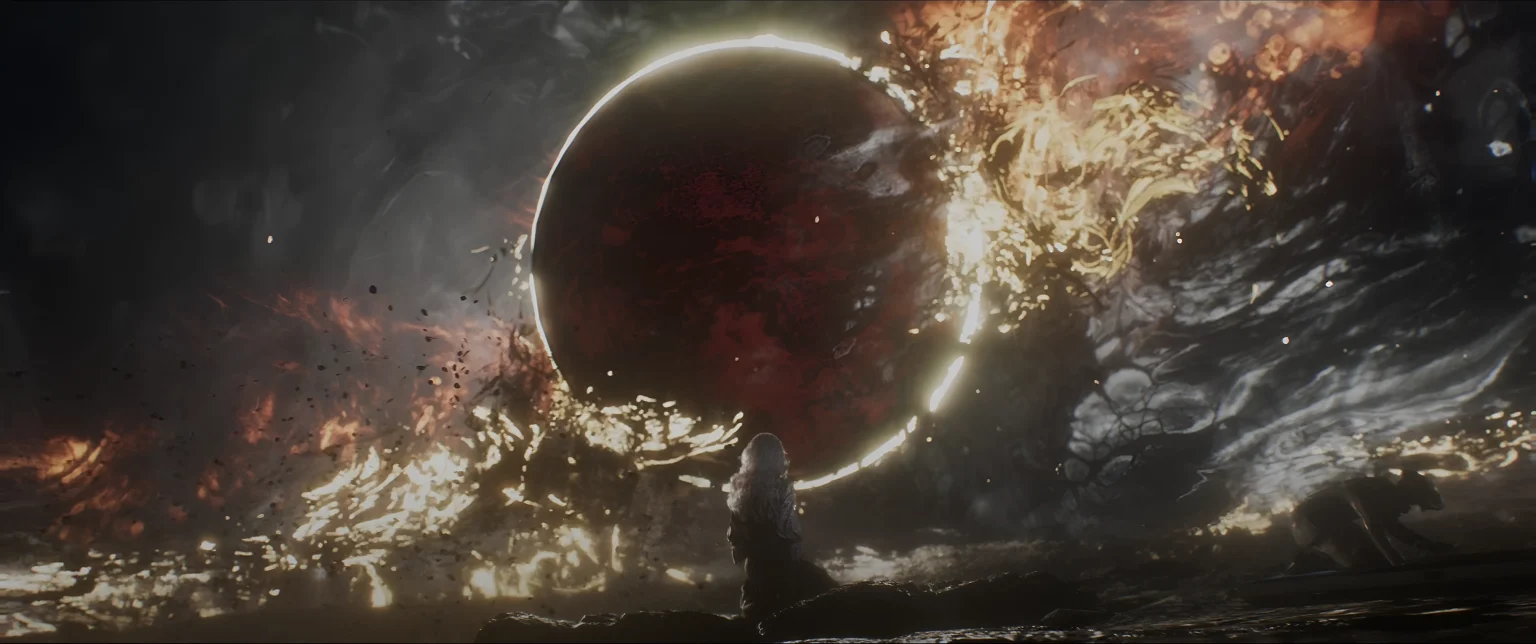
Expedition 33
9 minutes • November 16, 2025 • Thoughts
If you have not played this game, I would highly recommend not reading this review and to experience it with as little outside influence as possible. Stories like this bring joy to my life. Discover that joy for yourself.
There are six contenders for this year’s annual Game Awards game of the year section, but it seems clear now that Clair Obscur: Expedition 33 is most likely going to sweep the competition. This is not an easy year to win either, with excellent games like Hollow Knight: Silksong, Hades II, and Death Stranding 2 as strong contenders for the GOTY title, as well as other monsters like Blue Prince, Dispatch, and Talos Principle 2 lurking in other categories. At the end of the day, it doesn’t really matter who wins this year because we, as the audience, are the real winners.
However, when I picked up E33 last month, within the first three days of playing, I was sure that this game was my game of the year. This game, especially played in French, is one of the most beautiful games I’ve ever played.
Significant spoilers for Attack on Titan and E33 below.
Premise and Inspirations
Two things stood out to me immediately, the premise to the story and how the story was told. As you begin the game, there clearly exists a momentum of action and terrible tragedy that does not begin with Gustave or Maelle. These characters exist in a terrible, but also beautiful world where people are trying to make the best with what they have. And then the events of the story begin to move. We understand what the citizens understand, a giant woman next to a tower paints a number every year and everyone above that age disintegrates into flower petals.
Gustave and a small group of citizens volunteer to venture out from the city in an “Expedition” to stop the Paintress from killing the people of the city. But the Expedition is small because there have been many, many, expeditions before this one, and they always fail. After a disastrous failure to the start of the expedition, we’re thrown into the game facing off with enemies that seem larger than life, in a land completely foreign to ourselves and dissimilar to the world we’ve seen.
In a lot of ways, the premise and how the story is told mirrors the premise and story of Attack on Titan. In both stories, there is an unknown evil that continually and indiscriminately kills people, and it’s up to a brave group of people who put their lives on the line to stand up against this force and learn the truth of their world. Interestingly, however, the evil in AoT is not only the Colossal and the Armored Titan revealed in the first episode, but eventually author Hajime Isayama paints society at large and racism as the true “antagonist.”
E33 takes a much more western/French perspective on this similar story, and focuses our attention on one enemy, the Paintress, a giant enemy who kills indiscriminately (like the Colossal Titan). But like most good western stories do, it’s revealed that this person isn’t quite as evil as we expected when we first learned about them, similar to Attack on Titan as well. However, while Bertholdt can for sure hold responsibility for his actions attacking Eren’s city, the Paintress is very much misunderstood by those that view her as the enemy. In fact, there is a lot more depth to every character in the story, with most of the family painters being people with good in their heart, but flawed, dark executions of their desire (hence the title, Clair Obscur, or in English chiaroscuro, the contrast of light and darkness in paintings).
The Painters
When I finished the game, I couldn’t tell who I hated the most. At first, I was mad at Renoir for not trusting Alicia to step out of the painting when she needed to, having clearly seen how her mother’s grief had affected not only the painting itself, but everyone in the family. She is so lost in her grief she doesn’t understand that she needs to step away from the painting for the others in her family. But, it turns out that Renoir was right. I picked Maelle’s ending because I trusted her to be able to leave the painting, and I didn’t think it was right for Verso to end the lives of so many that Aline had created. Turns out, I was wrong. But I don’t think there’s really a good choice (I assume Verso’s ending is similarly selfish and damaging to the other person, but I haven’t checked as I’m saving that for my next playthrough).
Even though Aline and Renoir are not good people, now that I’ve played through the game, I don’t really blame them for doing the things they did. I don’t really think they were right, but I think how they acted was infinitely better than Clea, Alicia, and Verso’s soul. For Maelle to essentially torture Verso’s soul for the rest of his life, especially because that soul DOES NOT want to paint, is very disgusting, selfish, evil behavior. And for Verso’ soul to similarly destroy the souls of the human beings and creatures who give comfort to the family who lost him, and especially to the girl whose life is essentially ruined by disfigurement and disability, also is disgusting and terrible behavior. And for Clea to just ignore everything her family is going through, create the Nevrons, and then dip out to get revenge against the writers is equally terrible. Aline is lost in grief and Renoir is doing what she taught him to do, what a good husband should do. But to destroy the painting is also terrible.
Clair Obscur, literally light dark in Italian/French, truly represents the souls of these painters, as well as being a perfect tie-in to the plot and world of the game. There is a lot of darkness throughout the canvas, but we are front and center cheering for the light to prevail as well. While it can be easy to point fingers in these stories, such as at Renoir or Reiner, the true antagonist isn’t people, it’s concepts. Eren doesn’t have to do anything if he doesn’t live persecuted behind walls. Renoir and Aline do not enter the canvas if Verso doesn’t die. They’re not the antagonists, grief is. Grief controls all these characters’ actions, and makes them do terrible things to each other and the world around them.
This is ultimately why I regret my choice of going with Maelle. Not only because she betrayed me, but because on further reflection, Verso’s desire to destroy the painting is fundamentally the right thing to do for his family. Just like Eren in AoT, what else can he do? It’s selfish, it destroys the world around him, he even dies in the process. But is this too high of a cost for freedom? For himself, for his family?
Thoughts on Artificial Life
E33 got me thinking a lot about the value we place on life fundamentally. In stories such as Ghost in the Shell and Frankenstein, the authors make strong arguments in favor of considering artificial life as equivalent to human life. One popular example of this in American cinema is the classic Blade Runner of the 1980s and Blade Runner 2047 more recently.
But a few months ago I read the book Do Androids Dream of Electric Sheep? (DADES) and I found myself a bit shocked at what I read. As one of the foundational works that consider artificial electrical life to be equivalent to humans, DADES is actually much more anti-electrical life than I expected. Without getting too much in the weeds, some of the main cyborgs of that book are painted as sociopathic and strongly deserving of death.
While I don’t believe even slightly that any of the beings in the painting of E33 should die, hence my decision against Verso, E33 has made me wonder if the cost of saving those in the painting is worth the cost of enslaving Verso and keeping Alicia chained (by herself) in the painting. Does Aline’s talent at painting intelligent life immediately override the needs of Verso’s soul. Does the uniqueness of the people of Lumiere really necessitate the enslavement of Verso’s soul, especially if Aline could paint people like this again in a different painting?
E33 and DADES make me wonder if a belief I held unquestioningly before actually has more nuance than I expected.
Critiques
Before I wrap things up, I would be remiss if I didn’t mention some things that I did not like about this title. Just like every other work, there are things I believe can be improved, and things that I wonder if they’re going to be omnipresent in all of the works of Sandfall Interactive.
Gameplay
While the gameplay is pretty good, I don’t think (IN MY OPINION) the JRPG genre has almost any life left in it at this point. E33 does a good job at giving the genre a fresh coat of paint, but fundamentally I think games should be moving closer towards where games like Sekiro, Kingdom Hearts 2, and Elden Ring are pushing the industry (even if you have to tone down the difficulty). Funnily enough, I think the combat achieves a similar vibe to these games with the precision required in parrying in the combat, however, I think the lack of live action makes it a little less dynamic like sports/combat feel like in real life. The strategy of planning out attacks and overall battle strategy that JRPGs bring definitely elevates the gameplay to an overall enjoyable experience though.
Story
The ending is awesome and definitely carries most of the last act, but I think there could’ve been a little bit more layering of the revealed information, or that information could’ve been fed to us a bit more gradually, or have additional information to reveal. I’m not quite sure how I would do it, and I think if we were playing darts or something, this story hits near dead center, but there might be a bit of room for improvement in how the information is revealed. Having most of the information at the front and back of the Acts gives a lot of freedom for the gameplay, but I wonder if it’s at the cost of the story. Could a game like this benefit from casual character interactions like in TLOU/TLOU2 when you are casually walking through a level, looting things for survival, and the characters just start talking to each other in a low stakes way. Many of the interactions of E33 feel like Mass Effect 2, when you go to your ship and have a conversation with one of your crew members, then do something random so you can trigger the next interaction. While the structuredness works at the end of the day, some of the low budget bleeds through in moments like these.
I hope there is more blending of gameplay and story in future Sandfall games.
Music
Finally, I think the music is great sometimes and okay at other times. I think there is a lot of stuff that pushes the envelope in really cool, unique ways, but I think some of it is kind of… strange? The fusion of high intensity rock with classical compositions in songs like “Un vie a T’aimer” is cool and fun to listen to, but lacks a certain timelessness and listenability that other game compositions or even other songs in the game like “Clair-Obscur) possess (IN MY OPINION). Other tracks like “Aline” have that kind of classical, acoustic sound, but transitions suddenly tonally from something calm into something much more aggressive, while still retaining the same style. “Aline” succeeds compositionally in a way that something like “Un vie a T’aimer” tries in the same way, but with poorer execution. I know nothing about music though, I am but a humble dumbass (goes for everything else in this review honestly).
Conclusion
Et maintenant, je dois aller. Au revoir, mon ami.