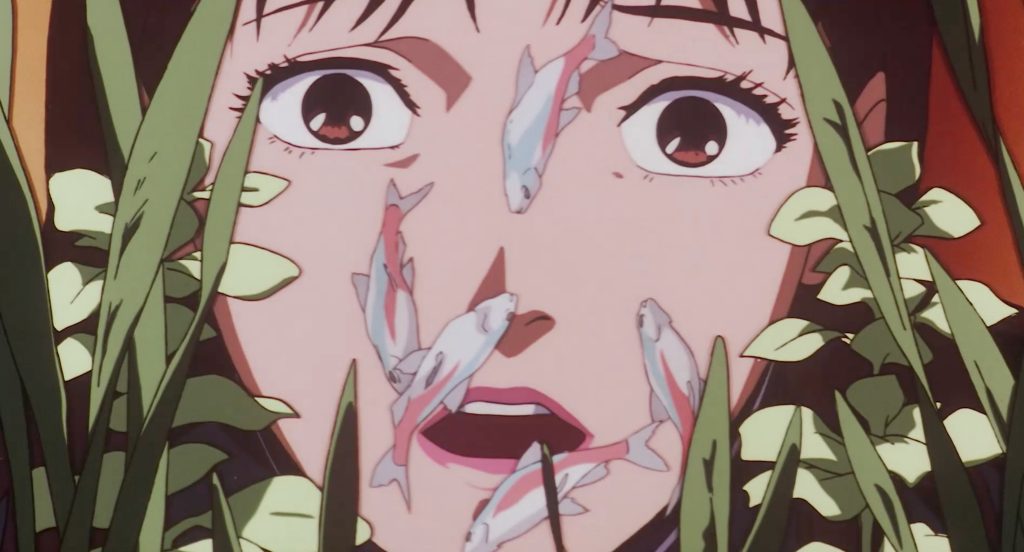
Perfect Blue
7 minutes • June 25, 2025 • Thoughts
If you’ve never watched Perfect Blue, stop reading this and watch it, then come back. This film inspired Black Swan and is worth the watch. Massive spoilers lie ahead.
As someone who studied stories in university, it’s difficult for media to stump me. Perfect Blue was a movie where I had no idea what happened after. It took me somewhere between an hour and two hours to piece together why I felt like this, and what it meant. From some of the discussions I read online, I believe not many people grasp the beauty of the film and what it’s trying to convey through the way it’s told, so I want to add my voice to the chorus of analysis for this film.
First, everyone who watches the film should understand that we should never be too sure of what events actually occurred. I think there are many valid interpretations I saw afterwards of what could’ve happened, so let me walk you through some of the more prominent ones, then we’ll try to piece together what they mean.
The Wikipedia Theory
This is the most straightforward interpretation of the film that most people will walk away with, and how Wikipedia describes the plot. Mima is struggling with her new life as an actress, and while she does experience some psychological distress through transitioning from an idyllic, child-like job as a pop idol to a much more “adult” job acting in mainstream television with its extremely adult themes (sexual assault) and promotion methods (nude photography), it’s nothing compared to what Rumi and Mima’s stalker, Me-mania, are experiencing. Rumi works with Mima’s stalker, feeding him information about Mima, and eventually sending him after the actress. After this fails, Rumi experiences a complete psychotic break and tries to kill Mima.
After Rumi is apprehended, she is committed to a psychiatric ward where she continues to believe she is Mima’s pop idol form, and Mima continues living life happily as an actress.
This interpretation is probably what most people walk away from the film “believing.” But let’s take a look at some other theories.
Double Bind is Truth
Mima transitions her career by appearing in the detective show Double Bind. However, there are many oddities about this show and her experience in it that don’t quite add up. Throughout the show, Mima regularly cuts in and out of “reality,” causing her to slip up during her performances and not really understand where she actually is at times.
In this theory, the show is what’s actually happening in Mima’s real life, and the events that happen outside of the show are Mima’s psyche’s attempt at coping with the events that are happening in the show.
One example: the sexual assault that occurs “in the show” actually happens to her in real life. When I watched this scene, I had alarm bells ringing in my head. It was uncomfortable, and not just because it was a sexual assault scene, but because of how long it went on. That scene’s duration and explicitness were not normal for a TV show. Similarly, Me-mania’s rape/murder attempt is now viewed not as something real that happens, but as an empowering reimagining of an assault in which Mima has control, what she wishes she could have done in her previous assault (think about how Mima fights it off perfectly, how she receives the applause afterwards).
Right before filming wraps, Mima is being interrogated by the police. In this theory, this is reality. She is actually responsible for the murders that we’ve seen her pop-idol version commit (Rumi/Me-mania in other versions), and she is now facing the consequences of her actions. After this, she is completely subsumed into her own fiction. It’s only then we realize that Mima is a projection of Rumi, who has completely broken down, who chases the projection of herself through the streets.
In the mental institution, Rumi still sees herself as Mima’s pop idol version, but also imagines one version of herself still living outside the prison, serving as a final psychological barrier for the Rumi/Mima hybrid that can’t cope with being locked up.
Don’t worry if you don’t completely understand what’s going on here. Let’s just say “TV show real,” and everything else cope if it’s too difficult and move on to the next theory.
Mima is Insane, Rumi is Sane Theory
This was the first theory I read about the film, and one that I find harder to believe. In this theory, Mima’s transition from being a pop star to an actress breaks her psychologically. We see this breakdown throughout the filming of Double Bind. As she enters her new life, she breaks internally, with part of her recognizing that what she’s doing is wrong. In this interpretation of events, Me-mania only exists in the imagination of Mima, an imagining of her own audience who hates who she is becoming. Rumi, who is clearly heartbroken at Mima’s change, is not experiencing a psychotic break, but is actually trying to advocate for Mima wholeheartedly.
While part of Mima recognizes she can’t handle this new life, the other part of her feels she must commit to her new role as an actress, and that this new role is the proper “adult” thing to do. While the things she does are distasteful, she MUST do them. She feels she cannot go back to her old life, no matter how much she wants to, or sees herself going back (constantly seeing herself as the pop idol in mirrored surfaces, seeing herself with her other pop idol members broadcasting for the radio). So she decides to plow through her misgivings and embrace her new life.
Rumi then becomes an obstacle to Mima. While Rumi earnestly tries to intervene in Mima’s life (as she is clearly experiencing a psychotic break), Mima imagines this intervention as a physical attack on herself, a final, jealous, insane outburst by someone who used to look out for her. In this version of events, the final chase is not Rumi trying to kill Mima, but trying to stop her from hurting herself. Rumi’s imprisonment in the mental asylum can then be seen through a literal lens as Mima convinces the police that Rumi is responsible for the murders/is insane (not super likely), or as a psychotic imagining which signals the metaphorical defeat of Rumi and the final acceptance of Mima’s life as an actress (Rumi not in psyche ward, but Mima imagines Rumi has been committed).
Regardless of your interpretation here, Rumi fails to save Mima, and her break from reality is complete. Here she completely accepts her new life as an actress, and her final line to the camera where she uses her real, authentic voice (only used one other time in the film), is a complete acceptance of her new, distasteful life.
Infinite Interpretations
These were just the main theories I could find. There are probably even more involving Me-mania or other characters. After finishing the movie, I read through some of these interpretations while trying to figure out what I thought happened. Which of these should I believe?
It was while scrolling through some comments on Reddit where I read an exchange that made everything click.

When I first read this, I just read the first two comments and died laughing. It was too funny not include here. But a few minutes later, as I was scrolling idly through some of my tabs while trying to understand what I actually thought happened, the final comment in the chain hit me. This, combined with the other theories above, was enough to make me understand what was really happening in the film.
The Audience
But first, we should back up a little and talk about the themes of the film. Regardless of your interpretation of the events, Perfect Blue clearly revolves around questions of identity, for Mima, for Rumi, and for Me-mania (who impersonates Mima online). But a hidden fourth character is the one that truly drives each of these characters to madness: the audience.
There is almost too much to talk about with director Satoshi Kon’s view of audiences, especially his unique take on 1990s Japanese media’s shift and how average audiences consume that media. Clearly, he criticizes the audiences of pop idols, so stuck in their ideal views of these women that they forget to see them as people who can change (see Me-mania and Rumi). He also subtly criticizes these audiences through the lens of Rumi’s failed career by saying her looks didn’t t fit the “taste” of those audiences. She is not attractive enough for the likes of Me-mania, someone who believes he is better/more moral than the degenerate mainstream viewers who pick apart Mima’s “innocence.”
On the other hand, Satoshi also criticizes Japanese mainstream media, who consider their own content “mature,” but are really just consuming/idolizing these beautiful young women in the same way that pop idol audiences do. Once Mima turns to the mainstream, she is given a small role in Double Bind, until she is offered a larger part if she is willing to participate in a rape scene. From there, her popularity explodes. She becomes a main component of the show. She participates in nude photoshoots. Even though she internally struggles with this change, externally she feeds the public exactly what they want, with many unable to discern whether Me-mania’s blog “Mima’s Room” is Mima’s true interpretation of events or not.
So, each audience clearly does not understand what is really happening. The mainstream audience assumes everything is real while gleefully consuming this young girl (an Aristotelian sexual catharsis) through any medium they can get their hands on. The pop idol audience (as shown through Me-mania and, more severely, through Rumi) assumes that Mima is tarnishing herself and that the “real” Mima would never go through with these things.
We Are The Problem
And this brings us to Satoshi’s main message. I now understand that when I finished this movie, I had the correct reaction. When someone finishes Perfect Blue, they’re supposed to ask themselves: “What the fuck just happened?”
Satoshi purposefully designed Perfect Blue to have many different interpretations because he wants to criticize us, the other, real audience. Even though we are watching the events unfold in front of us, we really have NO idea what is actually true. Understanding this fundamental fact, that we do not know what happens in Perfect Blue, is the only way to correctly interpret the film. If you believe any of the theories I listed above, or any other interpretation of the events that occur, in Satoshi’s eyes, you are just as deluded as Me-mania, Rumi, and just as uncritical as the mainstream Japanese audience in the movie. If you think you know “the truth,” you are choosing to deny other truths which just as easily could exist.
Through the ambiguity of the plot/ending of the film, Satoshi teaches us through this experience that we MUST doubt anything we see on screen, no matter how real it seems, or how much we think we can believe it with the evidence available to us. The people you see on your screen are not real; they are trying to sell you on a false reality to entertain you. They live their own complex lives in the society you live in, and we, as people who consume media, need to be cognizant of this.
By presenting enough plausible evidence in the plot to make the watcher question what is real, Perfect Blue pushes us as viewers to pause and question the media some consume and react to without thought.